“It’s a true pleasure losing yourself in another’s imagined world.”
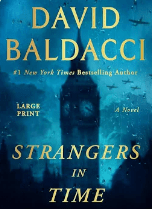
Some authors have a knack for creating wonderful stories set in grim situations and with Strangers in Time, David Baldacci joins their ranks. This novel features three equally main characters – Molly, Charlie and Ignatius – all navigating their lives and losses in London, during the Blitz.
There’s really a fourth main character, though: books. Ignatius owns The Book Keep, a bookshop that belonged to his late wife. Molly is an extremely well-read book lover and Charlie learns the power of filling a blank page. Books (and paper) are treated with reverence and respect in Strangers in Time. No wonder I loved it!
He followed her gaze as it swept across the shop. “I see you’re an avid reader,” he noted. “How did you know that?” she asked in surprise. “The eyes of a bibliophile are competent guides. They essentially sparkle when they alight upon books…”
Life was rough for everyone living in London during the Blitz, that dark time when Nazi Germany bombarded the city from the air, using missiles to kill, destroy, and sow panic. Imagine leaving your home and everything behind to rush to a bomb shelter only to return to a smoldering pile of rubble.
It was a surreal and harrowing time, brought to life through Baldacci’s research and his skill at interweaving historical tidbits throughout the novel. I learned that Londoners heard a terrifying whistling scream as the bombs approached the ground. Apparently the Germans riveted organ pipes to bomb fins so that as they flew through the air, a loud screaming voice was produced, instilling even more fear in the population. Diabolical.
In a taut and cinematic scene, Ignatius is caught outside during a bombing run, thinking “Before this war would I have ever imagined seeing two planes engaged in combat, flying down the streets of Covent Garden?”
Charlie is a scrappy young teenager, lying to his Gran about going to school, all the while working, hustling, scheming and stealing his way to daily hunks of bread and cheese here and a shilling there. But he’s not hardened – he has a generous heart and shares what he finds widely.
Molly was one of the lucky ones, children sent away to the countryside to stay with relatives during the war. She thrived as best she could but eventually made her way back home. Her house was there, their longtime housekeeper still there, but her parents were not. Eventually, Molly learns the upsetting truth about both her parents, two of the sad mysteries in the novel.
The audiobook narrators perform expertly, with accents, inflections and timing that do justice to Baldacci’s words. Stewart Crank’s Charlie is all scrappy swagger and sincerity; Alexandra Boulton’s Molly is kind and slightly imperious in a way that only well-bred Brits can be; and John Lee’s Ignatius is quietly calm and wise.
I love the particularly British expressions that Baldacci highlights, like in an early scene when Charlie recalls a recent visit to a library to escape the rain. He kind of resented the neat shelves of books all lined up, thinking, “It simply did not seem right when the world itself was all sixes and sevens.”
Strangers in Time is no fairy tale, but it is an exciting and engaging read, with a message that there can be bittersweet happiness ever after. As Molly reflects,
Grief, sadness, anger at a loss, and terrible, unrelenting hurt were the cost to be paid for loving and being loved. It felt completely worth the bargain right up until the moment payment was demanded.

 bookthrasher
One thought on “Strangers in Time”